
Where Old Oklahoma Mugshots May Be Found
Oklahoma offers no one-stop booking photo archive. The Oklahoma Historical Society keeps state-prisoner cards. The Oklahoma State Archives holds government records that agencies transferred. Courts keep dockets. Newspapers may carry old reports or images. A sheriff or jail may still hold a booking register. And the public record law does not make an agency keep a record forever or build a searchable photo site.
Start by naming the record you want. A county booking photo, a prison identification card, a court docket, and a newspaper image are not interchangeable. The jail-record finding aid shows that transferred material can be arranged by county and date. OHS prisoner cards cover state prisons only. Neither collection proves every Oklahoma mugshot survives. If the image is missing, ask which agency created it and whether it was kept, transferred, digitized, or destroyed.
Oklahoma's Documented Archive Collections
These collections are starting points. They do not promise an old county mugshot is online. Search by name, county or prison agency, and likely years. Items not digitized go through the repository's own request process.
The Oklahoma Historical Society's prisoner-card collection page lays out its search path. It also explains the photo-card request steps in detail.
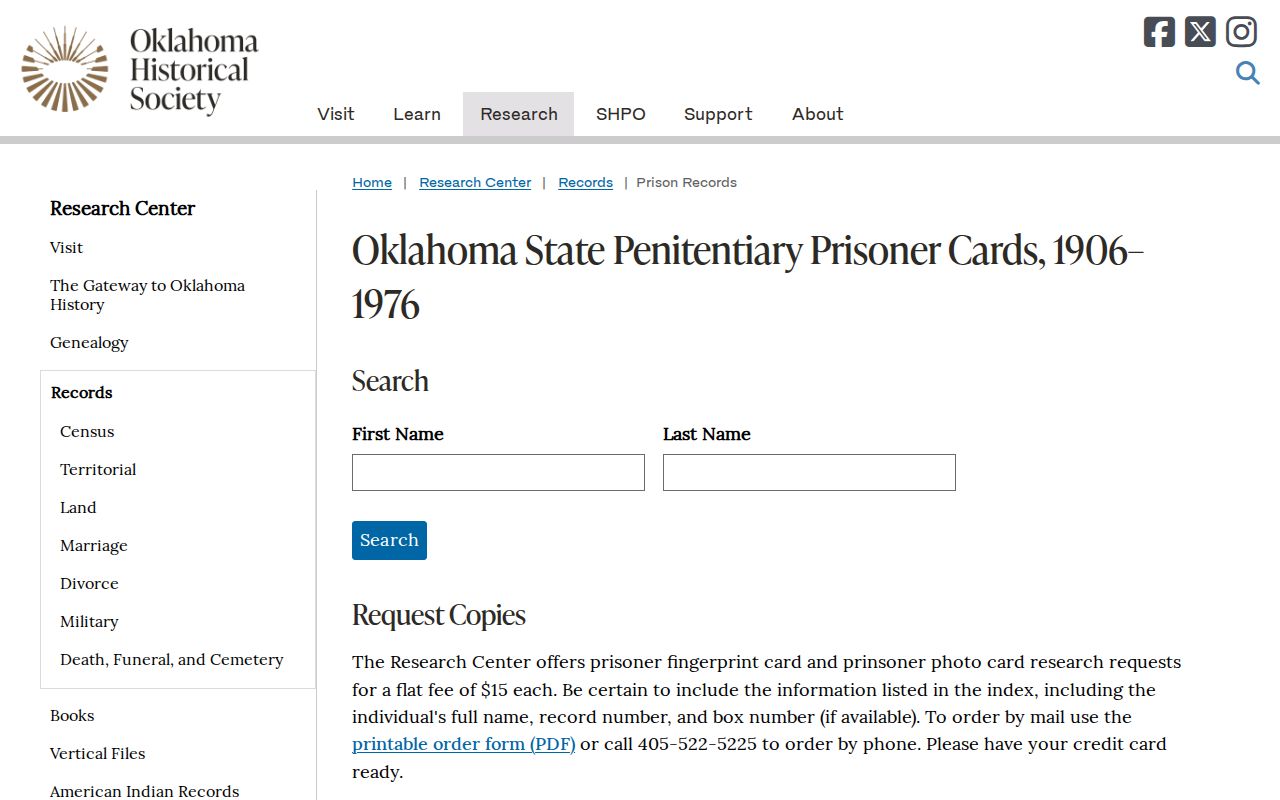
The page documents a state-prison collection. It does not show that every card survives or can be viewed online.
| Collection | Where | Era or scope | How to access |
|---|---|---|---|
| Oklahoma State Penitentiary prisoner picture cards | Oklahoma Historical Society | 1906-1976 | Search the prisoner-card page. A photo-card request should include the full name, record number, and box number if known; not every card is available. |
| OHS intake ledgers | Oklahoma Historical Society | Generally 1909 into the 1950s, with gaps | Give an approximate month and year when requesting a search. |
| Department of Charities and Corrections jail records | Oklahoma State Archives | Transferred material can be arranged by county and date | Use the finding aid, then ask the Archives about the relevant series. |
| Transferred jail or corrections records | Oklahoma State Archives | Varies by agency, series, and what was appraised and retained | Search finding aids and digital collections; request materials in advance when needed. |
| Historical newspapers | Oklahoma Historical Society newspaper resources | Depends on title, issue, and surviving holdings | Search the newspaper collection by place, date, and name. An article is not an official booking record. |
| Court dockets | OSCN or ODCR | Case dates in participating courts or the ODCR coverage area | Search the case record and read its entries; a docket is not a source for a booking photo. |
OHS describes picture cards, fingerprint cards, prison rodeo records, guard logs, and intake ledgers. A prisoner card may hold a photo, work details, and personal facts. It records state-prison history, not every county arrest. Keep that distinction in any note or citation.
Oklahoma Retention Rules for Old Booking Photos
No single statewide lifespan governs every Oklahoma booking photo. Under 51 O.S. §24A.8(C), the Open Records Act does not make an agency create a record or keep it forever. Title 19 §517.1 lets county governing bodies set retention, disposal, or digitization terms for records not otherwise addressed. None of that sets a uniform end date.
Retention turns on the county's approved schedule, the record series, legal holds, litigation, or an archive transfer. A sheriff may keep a register, not the image. An archive may hold a register minus its attachments. A fixed number of years should never be repeated as a statewide rule unless the agency schedule says so. Ask the custodian which schedule applies. Ask whether it was destroyed, digitized, closed, or moved.
Note: A missing photo in an online search can mean the record was never published, was not digitized, or no longer survives.
How to Request an Oklahoma Archive Record
A precise request helps an archivist. It can separate a jail register, a prison card, and a court file. Include what is known. Keep the date range narrow. For an older photo, ask for the record as held and its source. Do not ask the agency to certify guilt or legal history.
- Write down the full name, county, arresting or holding agency, approximate date, and any case or prisoner number. Say whether you seek a jail register, booking photo, prisoner card, court file, or newspaper image.
- Search the State Archives finding aids and digital collections. For transferred Department of Charities and Corrections jail records, use the county and date details in the finding aid to identify the relevant series.
- For state-prison history, search OHS's prisoner-card collection. Include the full name, record number, and box number if known. For an intake ledger, provide an approximate month and year because the ledgers have gaps.
- Contact the State Archives at archives@libraries.ok.gov about access and advance requests. Some collections require four to six weeks' notice before a visit, and materials remain in the archive.
- Check current copy and access terms before ordering. OHS lists a flat fee for prisoner photo-card requests; confirm the current amount and form on its order path before sending a request.
- If the archive has no item, ask the present sheriff, jail, court clerk, or agency whether the record was retained, transferred, or disposed of under its schedule.
Oklahoma State Archives request route
Repository: Oklahoma State Archives, housed within the Oklahoma Department of Libraries. Email them at archives@libraries.ok.gov with your request.
Plan ahead: Read the access and temporary-location notice first. Some collections must be requested in advance. Nothing leaves the building.
Start any archive request with a phone call. The Archives can tell you whether a collection sits at its temporary location or how much notice it needs. Some materials require four to six weeks of lead time, and they stay in the repository the whole time you work with them. Ask about copy fees too. Charges apply for copying, and the posted rate is the one to plan around.
Know the access rules for cameras and scanners. The Archives permits them under its current terms, though restrictions can change. Checking first saves a wasted trip for a series that is not ready or a copy the staff cannot produce in your format. One more thing: OHS runs its own prisoner-card searches. An Archives request will not replace that, so route each record to the right office.
What Oklahoma Archives May Not Hold
A series title does not mean every record survived. The State Archives finding aid covers transferred jail records by county and date. A county entry does not prove every mugshot was kept. OHS prisoner cards have their own availability limits. Its intake ledgers contain gaps. A newspaper image shows what was published at the time, and that is its value. Label it as a newspaper image. That holds unless its provenance marks it as an official booking photograph.
When a record eludes you, follow its trail of custody. The agency that made the arrest may not be the jail that booked the person. The court clerk, not the jail, holds how the case ended. Ask each office which record series it searched. Ask what retention schedule applies. If files moved to an archive, get the collection or box reference. Keep the county and case number with that citation.
Note: A state-prison card should not be relabeled as a county booking photo unless the record itself supports that description.
Recent Oklahoma Arrest Records and Older Archives
Start with the sheriff or jail holding the current booking record. The statewide Oklahoma booking-records page maps the roster, records-request, and court routes. To go local, the County Directory points to each county site. Older cases drop off a live roster over time. They can still surface in a docket, an archive series, a newspaper file, or a prison collection. Each source answers a different question. The same event may even carry different names or dates across them.
Cite each record by its own label. A booking photo shows intake. A jail register shows custody. A docket tracks court events. An archival card can mark a state-prison admission. A disposition is the court's outcome, and no photo or old roster can supply it. The chain runs arrest, booking record, court case, disposition, then transfer or disposal. Records sealed or expunged under Title 22 follow the court order and agency process. Never assume every old copy disappeared.
For family or local-history work, note the repository, collection, box or case reference, date range, and source type with every copy you make. Provenance keeps the trail honest. It also stops a prison file or news photo from becoming a false claim about a county booking.
Note: The statewide research snapshot is dated September 22, 2026; confirm current access details with each archive before planning a visit or order.